
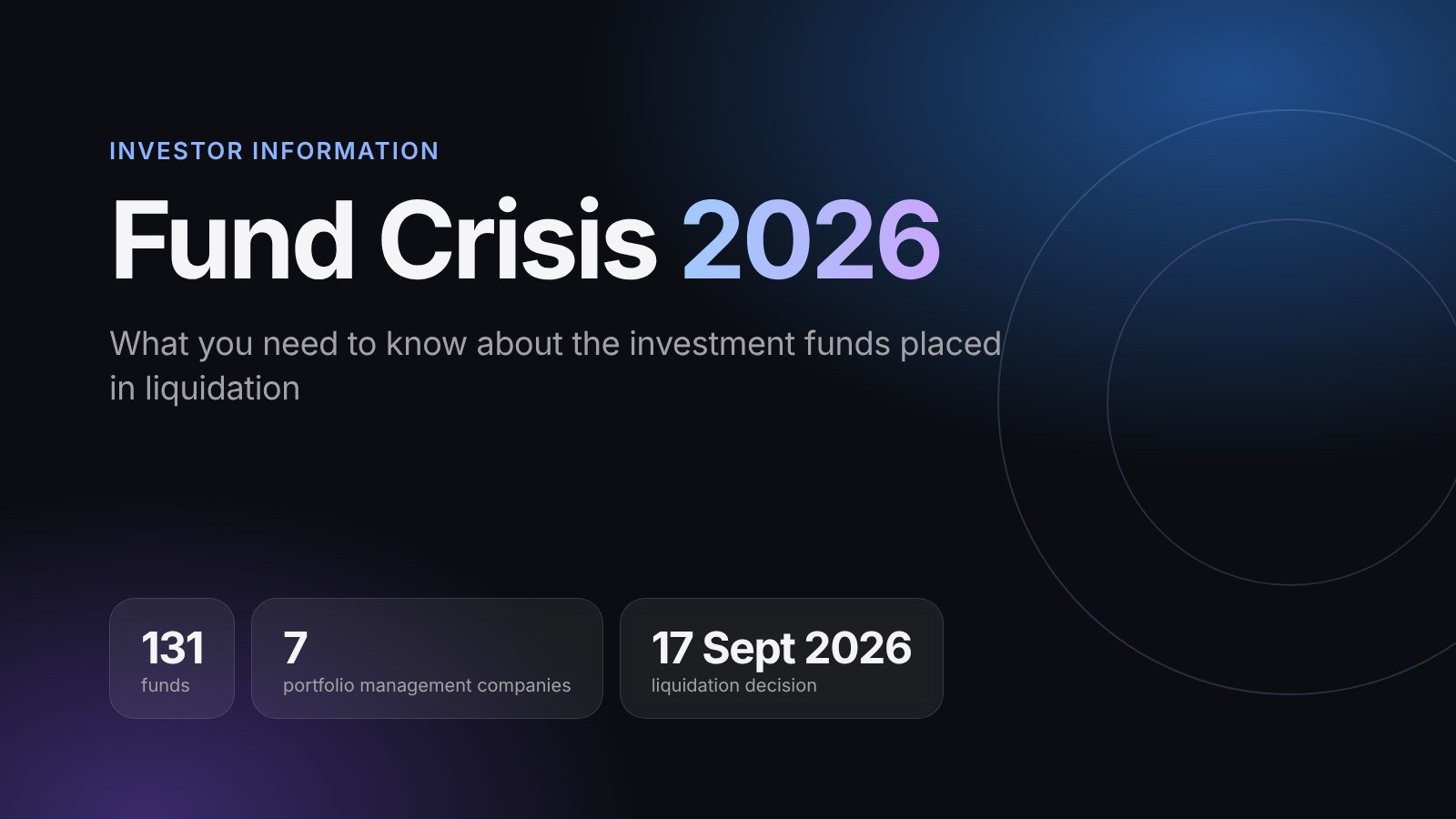
The law for the funds in liquidation has been adopted by the Turkish Grand National Assembly. It sets how payments will be calculated, how money taken out of the funds will be recovered and who will receive nothing. For some investors it is good news; for others it is a clear loss. Below we examine the adopted text article by article and assess its effect on litigation.
In brief
- Narrow scope. It applies only to the funds placed in liquidation by the Capital Markets Board (SPK) decisions of 17 September 2026 whose liquidation is not complete on the date the Law is published. It does not create a general regime for other funds. 1
- If cash falls short, payment follows the “net investment amount”. If the fund’s cash is not enough to pay everyone at the 16 September price, payments will be based on the money the investor actually put in and took out, indexed to inflation. Paper gains will not count. 1
- Interim payment of up to TRY 1 million. It will be made in funds designated by the SPK; if cash is insufficient, payments may start with the smallest investors. 1
- Bad news for holders of blocked units. Investors whose units were blocked under orders given on or before 17 September and never executed will be subject to the liquidation as unit holders, not as priority creditors. This provision was added in the General Assembly. 1
- Strong tools to recover diverted money. Value taken out of the funds without consideration is deemed a loss; the founding portfolio management company is liable first, then persons designated by the SPK personally. The Savings Deposit Insurance Fund (TMSF) will collect these claims like public receivables; confiscated assets go to the fund, not to the Treasury. 1
- It applies retroactively. The Law enters into force on publication, with effect from 17 September 2026. 1
- It does not close the courts. There is no bar on litigation, no special rule for pending cases and no limit on the SPK’s liability. But money recovered through litigation will be deducted from the final payment. Time limits keep running: 16 November 2026 is the nearest cautious date. 1
Text and status. The Law was adopted by the General Assembly of the Turkish Grand National Assembly (TBMM) on 22 October 2026 and numbered 7596. As of 24 October 2026 it has not been published in the Official Gazette. The President must publish it within 15 days of receiving it or return it to parliament for reconsideration. 2 Quotations below are our translation of the adopted text published by the TBMM. 1 The authoritative text will be the one published in the Official Gazette. Passages marked “Assessment” are our professional opinion; no provision has yet been applied by the courts.
What does the Law regulate? Nine articles
| Article | Subject | Why it matters to investors |
|---|---|---|
| 1 | Purpose and scope | Which funds are covered |
| 2 | Definitions | A “fund unit holder” is identified by reconciling Central Registry (MKK) and liquidator records |
| 3 | Conduct of the liquidation, unit holding | Broad SPK powers; blocked units; who receives no payment |
| 4 | Net investment amount, interim and final payment | How much you will receive |
| 5 | Value unlawfully removed from the funds, personal liability | From whom and how money will be recovered |
| 6 | Seized and confiscated assets, recovery account | Money from the criminal case returning to the fund |
| 7 | Outsourcing, applicable law | SPK implementing rules |
| 8-9 | Entry into force, execution | Effective from 17 September 2026 |
Who does it cover?
Funds. The Law covers investment funds placed in liquidation by the SPK decisions of 17 September 2026 “whose liquidation has not been completed on the date of publication of this Law”. 1 Its provisions “do not create a general or permanent liquidation and liability regime for other investment funds”. 1 It is a law for one crisis.
(Assessment) The “not completed on the date of publication” test may matter for funds in ordinary liquidation. A fund whose liquidation is completed before publication falls literally outside the Law, and it is unclear whether its investors could then benefit from the recovery account and confiscation provisions. We have seen no official statement that any fund’s liquidation has been completed so far.
| Who | What the Law says | Result |
|---|---|---|
| Investors whose units remain in the fund | “Fund unit holders”; payment calculated under art. 4. 1 | Interim payment and share of the liquidation balance |
| Investors who gave a redemption order on or before 17 September, were not paid and had their units blocked | “Subject to the liquidation provisions of this Law as fund unit holders.” 1 | Not priority creditors; same rules as other holders |
| Investors who left the fund before the crisis | May “voluntarily” return returns above inflation to accounts announced by the SPK. 1 | No compulsory clawback |
| Persons found by the SPK to have taken part in market manipulation, insider dealing or market fraud | No payment from the liquidation or the recovery account. 1 | No payment even if they hold units |
| Founding portfolio management company | Liable for the fund’s loss “in the first place”. 1 | Collection by TMSF |
| Managers, controlling shareholders and others designated by the SPK | “Personally liable” if the company cannot pay; leaving office does not end liability. 1 | TMSF collection against personal assets |
The institutions applying the Law are also defined: the SPK sets the method, the liquidators sell assets and pay, the MKK calculates the net investment amount, the TMSF keeps the recovery account and collects from those liable, and the Investor Compensation Centre distributes recovered amounts after the liquidation ends. 1
What does it give?
1. A clear statutory basis for the liquidation
The SPK based its 17 September liquidation decisions on the general powers clause (art. 128/1-a) and the measures clause (art. 96/1) of the Capital Markets Law. 3 Those general provisions were open to challenge as a basis for a detailed distribution regime that alters investors’ claims. The Law now expressly empowers the SPK to set the stages of the liquidation, valuation principles, how unit holding is determined, interim and final payments and the order of distribution. 1
2. Money actually invested instead of inflated values
If the cash raised by selling the fund’s assets is enough to pay everyone at the closing price of 16 September 2026, that price remains the basis. If not, payments will follow the net investment amount. 1 It is calculated as follows:
- Inflows and outflows are indexedEvery amount you actually paid into or took out of the fund is uplifted, pro rata temporis, by the arithmetic average of the change in consumer prices (CPI) and domestic producer prices (D-PPI) up to the liquidation date.
- Outflows are deductedIf your inflows exceed your outflows, each payment you received from the fund is deducted on a first-in, first-out basis.
- The balance measures your shareThe MKK makes the calculation. The fund’s cash is distributed in proportion to these amounts.
(Assessment) The logic is that gains computed on prices allegedly inflated artificially should not be shared out. A recent investor who bought at a high price is protected compared with a distribution based on unit price, and their money is not eroded by inflation.
3. Interim payment of up to TRY 1 million and priority for small investors
In funds designated by the SPK, investors with a net investment below TRY 1,000,000 may receive that amount, and those above it up to TRY 1,000,000, as an interim payment. 1 The interim payment may not exceed the unindexed net investment or (except in money market funds) the previous day’s value of the units in the account. If cash is insufficient, the SPK may pay starting from the smallest net investment or set a minimum amount for everyone. 1 Interim payments are deducted from the final payment. 1
(Assessment) The “smallest first” rule aims to make as many investors as possible whole. It works in favour of small investors and against large ones.
4. Recovering diverted money
- A broad definition of unlawfully removed value. Value transferred to related parties or third parties in breach of the rules, or “even if formally compliant” without a genuine economic purpose in the fund’s interest, through loans, advances, collateral, repo, reverse repo and similar transactions made without consideration or as sham transactions, is deemed to have caused a loss to the fund. 1
- Chain of liability. First the founding portfolio management company; if it cannot pay, the natural and legal persons designated by the SPK, personally. 1
- Fast collection. The SPK notifies the TMSF of the loss and those liable; the TMSF collects under Law No. 6183 on the collection of public receivables and certain Banking Law powers. Istanbul administrative courts have jurisdiction over cases concerning these proceedings. 1
- From the criminal case to the fund. The SPK’s reports underlying its criminal complaints count as the report required for seizure. Cash and securities that can be returned to the fund may be returned directly; confiscated assets go to the fund instead of the Treasury. 1
- A protected account. The recovery account is kept separately for each fund, apart from the TMSF’s own assets; it cannot be used for any other purpose and cannot be attached even for public receivables. 1
5. Access to information
The MKK, Takasbank, the exchange, banks, portfolio management companies and custodians may not withhold information requested by the SPK, the Investor Compensation Centre or the TMSF on confidentiality grounds. 1
What does it take away? Risks and gaps
The biggest loss: priority for blocked units. Under item A-6 of SPK Bulletin 2026/61, the value of redemption orders given through TEFAS and not executed was recorded as a debt of the fund, and these debts were to be paid first in the liquidation. On 28 September the SPK said this rule applies to orders given on or before 16 September and not executed. 4 5 The Law now provides that, for orders transmitted to TEFAS on or before 17 September 2026 but “not executed because of the fund’s default and/or the failure to announce a unit price, those whose units have been blocked are subject to the liquidation provisions of this Law as fund unit holders”. 1 (Assessment) This wording moves investors with blocked units out of the priority creditor position and into the same distribution as other holders. Details will depend on SPK decisions. The provision was not in the bill; it was added by an amendment in the General Assembly. 6
- Retroactivity. The Law takes effect from 17 September 2026. 1 The blocked-units rule changes, with retroactive effect, a position the SPK had previously recognised. (Assessment) This is the Law’s most contested point in terms of the rule of law, legal certainty and the right to property.
- Long-term investors may lose their gains. The net investment method ignores returns above inflation. An investor who joined years ago and earned a genuine, legitimate return will also share only on the basis of inflation-indexed capital, and earlier withdrawals will be deducted. 1 (Assessment) No distinction is drawn between the alleged manipulation period and earlier, legitimate periods.
- Exclusion without conviction. A “finding” by the SPK is enough to bar payment; no court judgment is required. 1 By contrast, the Capital Markets Law requires a conviction to exclude someone from investor compensation. 7 (Assessment) This may raise issues under the presumption of innocence and the right to property; the finding can be challenged in the administrative courts.
- Clawback from early leavers is voluntary. Returning returns above inflation by those who left at high values before the crisis is “optional”. 1 There is no compulsory mechanism. Recovery from them is possible only if they fall within the “without consideration or sham transaction” definition of art. 5, or through criminal and civil routes.
- Silence on State liability. Payments are limited to fund assets and recovered amounts. There is no provision on the SPK’s supervisory liability, public funding or a compensation scheme. 1
- Wide powers, few safeguards. The funds receiving interim payments, the minimum amount, the order of distribution, valuation and allocation between funds are left to SPK decisions. 1 There is no deadline for completing the liquidation, no default interest and no investor objection procedure.
- The unit of the interim payment cap is unclear. The cap is set “for investors”, but the payment is made “from the liquidation assets of the relevant fund”. 1 For an investor holding units in more than one fund, whether the cap applies per fund or in total will be settled by the SPK’s implementing decision. The SPK’s pre-Law decision 64/1775 had set the cap per fund. 8
- Litigation proceeds are deducted. Payments previously received “through other legal avenues” will be set off against the final payment. 1 Litigation is therefore a tool to recover the uncovered loss, not an extra gain on top of the liquidation.
Differences between the bill and the adopted text
We compared the original bill submitted to the TBMM with the adopted text word by word. 9 1 Substantive changes were made at three points. The other six articles are identical to the bill apart from spelling corrections.
| Provision | Bill (9 Oct 2026) | Adopted text (22 Oct 2026) | Where it changed |
|---|---|---|---|
| Art. 2/1-c and art. 3/5, first sentence: identifying unit holders | Records of the MKK, Takasbank, TEFAS, custodians and distributors are reconciled | Reconciliation with MKK records only (the definition refers to MKK and liquidator records) | Planning and Budget Committee (press reports) 10 |
| Art. 3/5, second sentence: blocked units | None | Holders of blocked orders are subject to the liquidation “as fund unit holders” | General Assembly amendment 6 |
| Art. 4/4: voluntary return by early leavers | Only those who redeemed “at values formed contrary to reality”; benchmark: average return of peer funds in the same category | Anyone who redeemed before the liquidation date; benchmark: inflows indexed to the average of CPI and D-PPI | Committee (press reports) 10 |
| Art. 4/4: voluntary return of share gains | Shares whose price the SPK found to have formed contrary to reality; benchmark: index return | Shares the SPK has made subject to the market manipulation, insider dealing or market fraud provisions; benchmark: purchase cost indexed to inflation | Committee (press reports) 10 |
| Art. 8: entry into force | Effective from 17 Sept 2026, in force on publication | Unchanged | Unchanged |
(Assessment) As we could not see the committee report, we rely on press reports for whether the first and fourth changes were made in committee or in the General Assembly. Several sources consistently report that the blocked-units provision was added in the General Assembly. The art. 4/4 change addresses the call for voluntary returns to a wider group and simplifies the benchmark, but the return remains voluntary.
Effect on litigation
The Law closes no avenue of litigation, sets no rule for dismissing or staying pending cases and introduces no new limitation period. 1 It does, however, affect the substance and strategy of cases. As of 24 October 2026 we could not find any report confirming an annulment or damages action filed against the SPK; this does not mean none has been filed.
Annulment actions against SPK decisions
- Time limits keep running. Waiting for publication does not stop the clock. On a cautious calculation, the last day is 16 November 2026 for the 17 September decisions and 27 November 2026 for the 28 and 30 September acts. 11 See the Deadlines page.
- The lack-of-basis argument weakens. (Assessment) Because the Law takes effect from 17 September, the claim that “the SPK had no power to do this” will largely lose force. Arguments on equality, proportionality and the order of payment, and on whether new SPK implementing decisions comply with the Law, will remain open.
- New decisions, new deadlines. The Law gives the SPK power to adopt many implementing decisions. Each new decision starts a new 60-day period from its announcement. 1 11
- The door to the Constitutional Court. Individuals cannot challenge a law directly before the Constitutional Court. The open route is to argue, in a case filed in time, that the statutory provision is unconstitutional and ask the court to refer it (concrete review). 2 (Assessment) Annulment actions filed in time are therefore not only a way to set aside an SPK decision; they are the only practical vehicle for bringing the blocked-units rule and retroactivity before the Constitutional Court.
Damages actions against the SPK (full remedy)
The Law neither regulates nor limits the SPK’s liability for supervisory failures. 1 A written application to the SPK comes first; on a cautious calculation the deadline is 17 September 2027. 11 (Assessment) The Law’s effect is indirect: while the liquidation and recovery continue, the administration’s defence that “the loss has not yet crystallised” becomes stronger. Because of the set-off rule, damages should focus on the loss left uncovered after liquidation and recovery. 1
Claims against the founder, custodian and distributor
These remain open. The Law’s statement that the founding company is liable “in the first place” supports investors’ claims. 1 (Assessment) But since the TMSF will collect from the same persons’ assets, priority conflicts may arise between an investor’s own enforcement and public collection. Fund assets and the recovery account cannot be attached. 7 1 See Legal remedies for details.
Criminal proceedings
By directing seized and confiscated assets to the fund, the Law makes following the criminal case more important for investors. 1 See Criminal proceedings.
Constitutional Court: three different routes
| Route | Who may apply | When |
|---|---|---|
| Action for annulment (abstract review) | The President, the two largest party groups in the TBMM or at least one fifth of members of parliament | Within 60 days of publication in the Official Gazette 2 |
| Objection (concrete review) | The court hearing the case; the investor asks the court | During pending proceedings. If the Constitutional Court does not decide within five months, the court decides the case under the provisions in force. 2 |
| Individual application | An investor whose rights are violated | Not directly against a law; within 30 days after exhausting ordinary remedies against the act applying it 12 |
(Assessment) The main constitutional arguments against the blocked-units rule are the right to property (Constitution art. 35), the rule of law and non-retroactivity (art. 2), equality (art. 10) and proportionality (art. 13). The European Court of Human Rights has held that legislative interference designed to influence the outcome of pending proceedings, absent compelling reasons of general interest, violates the right to a fair trial and the right to property. 13 On the other side, the public interest in crisis management, the fact that the A-6 priority was granted by an SPK decision rather than by law, and the fund’s insufficient cash will be argued. The outcome cannot be predicted today.
What should investors do now?
- Check for a blocked entrySee in e-YATIRIMCI whether your units appear as blocked and check your order date. Investors with blocked units are the group most affected by the Law. 14
- Keep your account recordsThe net investment amount will be based on the money you actually put in and took out. Keep all purchase and sale confirmations, bank statements and interim payment notices. Document checklist
- Do not miss deadlinesDo not wait for publication; the nearest cautious date is 16 November 2026. Deadlines
- Follow SPK implementing decisionsEach decision adopted after publication may start a new time limit.
- Beware of fraudstersIgnore anyone saying “the law has passed, pay a fee to speed up your payment”. Payments are made through the liquidators. Scam warning
Once published in the Official Gazette. We will update this article with the publication date and number, and note any difference in the published text.
Sources
- Law No. 7596 on Certain Investment Funds Placed in Liquidation (text adopted by the TBMM, 22 October 2026)Adopted text published by the Turkish Grand National Assembly, 9 articles. Quotations in this article are translated from this text. Not published in the Official Gazette as of 24 October 2026; the authoritative text is the one published in the Official Gazette.
- Constitution of the Republic of Türkiyeart. 125: The administration is obliged to pay for the loss arising from its own actions and decisions. art. 152: The courts’ route for referral to the Constitutional Court.
- SPK Bulletin 2026/6017 September 2026. Decisions No. 57/1706 and 57/1707 of the Board’s decision-making body: suspension of trading on TEFAS in the funds of 7 portfolio management companies and liquidation of the listed funds.
- SPK Bulletin 2026/6117 September 2026. Decision No. 57/1708: the liquidation procedures and principles (paragraph A), suspension of transactions outside TEFAS (B), the current list of 131 funds (C).
- SPK Press Release, 28 September 2026Cancellation of the orders transmitted to TEFAS on 17 September 2026, and payment to the holders of those orders from the liquidation balance in proportion to their units.
- Press reports, 22-23 October 2026: General Assembly amendment (blocked units)Provision added through an amendment adopted in the General Assembly: investors whose units were blocked under orders transmitted to TEFAS on or before 17 September 2026 and not executed because of the fund’s default or failure to announce a price are subject to the liquidation provisions as fund unit holders (Bigpara, Ekonomim, Cumhuriyet, Ekotürk). The provision appears as art. 3/5 in the adopted text published by the TBMM.
- Capital Markets Law No. 6362 (SPKn)The text of the law in force. The relevant articles are indicated separately on each page.
- SPK Bulletin 2026/6730 September 2026. Decision No. 64/1770 (order of liquidation for the A1 Capital, Bulls and Pardus funds) and Decision No. 64/1775 (interim payment for the Tera, Pusula, Atlas and Hedef funds).
- Bill No. 2/3939, original text (9 October 2026)Original text and explanatory memorandum submitted to the TBMM. The article-by-article comparison with the adopted text is based on this document (Turkish).
- Ekonomim, 14 October 2026“Fon teklifi komisyondan geçti: Yatırımcıya ödeme nasıl yapılacak?” (Fund bill passes committee: how will investors be paid?). A summary of the text adopted by the committee.
- Administrative Procedure Act No. 2577 (İYUK)art. 7: time limit for filing suit (60 days in the administrative court). art. 11: optional application to the authority that took the decision before filing suit; it stops the time limit for suit, and 30 days without a response is deemed a rejection (reduced from 60 to 30 days in 2021 by Law No. 7331). art. 12: for loss arising from an administrative decision, a full remedy action either directly or together with an annulment action. art. 13: for loss arising from an administrative action, the requirement to apply to the administration first (within 1 year of learning of it and in any event within 5 years; 30 days without a response is deemed a rejection). art. 15/1-e: in an action filed without the prior application, the petition is sent to the administration.
- Law No. 6216 on the Establishment and Rules of Procedure of the Constitutional CourtIndividual application (art. 45 et seq.) and the objection procedure (Turkish).
- ECtHR, Stran Greek Refineries and Stratis Andreadis v. Greece, no. 13427/87, 9 December 1994Legislative interference designed to influence the outcome of pending proceedings to which the State is a party breaches Article 6 and Article 1 of Protocol No. 1 unless justified by compelling reasons of general interest.
- MKK e-YATIRIMCIThe official portal where you can view the units and movements registered in your own name.
Have a question?
These articles are general information. You can send questions about your own situation through the contact section or by e-mail.
Av. Dr. Mustafa Aykanat · Ankara Bar Association Reg. No 43042 · Yenimahalle, Ankara